Zeitz, Jana Friederike
Jana Friederike Zeitz, M.Sc. Geography
(area of specialisation: Urban and Regional Development Management)

Studied Geography with specialisation on Urban and Regional Development at the Department of Geography, Ruhr University Bochum.
Research interests:
- The right to the city
- Social and spatial inequality
- Urban and neighbourhood development planning
- Housing market and allocation strategies
Contact:
Phone: + 49 (0) 231 9051-244
E-Mail: jana.zeitz@ils-research.de
Job advertisement: Scientifc Director of the ILS
In conjunction with TU Dortmund University, we are looking for a person with a proven academic track record to lead the ILS—Institute for Regional and Urban Development Research. The position is linked to the W3 professorship in “Sustainable Real Estate and Land Development” at TU Dortmund University. We are seeking a leader with internationally recognized research expertise who will shape the strategic development of the ILS and drive the sustainable transformation of cities and regions. The application deadline is August 12, 2026. Further information on the requirements and the application process can be found in the job advertisement.
Verkehrs- und Mobilitätsgerechtigkeit als theoretisch-konzeptionelle Grundlage für die Analyse von Erreichbarkeiten
Increasing discrimination, rising poverty, an ageing society: Whether people can reach their everyday destinations is increasingly becoming a question of social justice. Particularly in peripheral rural areas, it becomes clear that even existing transport services do not automatically enable social participation. How, then, can accessibility planning be more consistently aligned with the principles of transport and mobility justice? Our ILS researchers Florian Ahlmeyer and Sören Groth explore this question in their new research article published in Geographica Helvetica. They discuss how international approaches to transport and mobility justice can enrich accessibility planning and complement the spatial planning principle of public service provision (Daseinsvorsorge). 👉 https://doi.org/10.5194/gh-81-567-2026. Further current selected papers can be found here.
The Open City and its Allies: Urban Planning Ethics in Practice
Stefano Cozzolino, a researcher of the ‘Spatial Planning and Urban Design’ research group, has edited an Open Access book in collaboration with Anita De Franco of the Polytechnic University of Milano. This book explores the concept of the open city, examining its theoretical foundations, normative implications, and real-world practices in contemporary urban planning. The chapters move from conceptual debates on openness and empirical cases, investigating how cities address key challenges such as democracy, freedom, inclusion, creativity, learning, governance, and urban change. By connecting urban theory with planning practice, the volume offers a critical yet accessible reflection on the future of cities. Developed through the work of the Thematic Group “Ethics, Values and Planning” of the Association of European Schools of Planning. More…
Innovationskongress NRW: Wirtschaft trifft Wissenschaft
Wie können innovative Geodaten die Klimaanpassung in Städten unterstützen? Beim Innovationskongress NRW am 8. Oktober in Düsseldorf zeigte das ILS anhand des Forschungsprojekts CATCH4D, wie Forschungsergebnisse zur Erreichung der Klimaziele beitragen können. Das Projekt und die darin entwickelte 3D-Wärmelandkarte wurden sowohl in der Ausstellung als auch im Kongressprogramm vorgestellt. Mehr…
Wissenschaft im Wirtshaus: Über dritte Orte an einem dritten Ort
Neben dem Zuhause und dem Arbeitsplatz gibt es einen weiteren informellen Ort der Zusammenkunft: den „Dritten Ort“. Bei der neuesten Ausgabe von „Wissenschaft im Wirtshaus“ im Restaurant Gdanska in Oberhausen entstand daraus eine lebhafte Diskussion. Begleitet wurde diese mit einem Impuls von ILS-Wissenschaftlerin Dr. Sabine Weck. Mehr…
Wissenschaft im Wirtshaus: Über dritte Orte an einem dritten Ort
Neben dem Zuhause und dem Arbeitsplatz gibt es einen weiteren informellen Ort der Zusammenkunft: den “Dritten Ort”. Bei der neuesten Ausgabe von “Wissenschaft im Wirtshaus” im Restaurant Gdanska in Oberhausen entstand daraus eine lebhafte Diskussion. Begleitet wurde diese mit einem Impuls von ILS-Wissenschaftlerin Dr. Sabine Weck.
Neben den allgemeinen Definitionen, die unter anderem auf das Standardwerk vom Soziologen Ray Oldenburg, The Great Good Place, aus den 1980er Jahren zurückgehen, standen vor allem neuere Untersuchungen und Projekte im Fokus. Gerade im Ruhrgebiet haben sich viele Initiativen hervorgetan, wie beispielsweise das Bürgerhaus Dorstfeld „Pulsschlag“ in Dortmund oder „Hier ist nicht da“ in Gelsenkirchen-Ueckendorf. Sie alle werden nicht nur durch festangestellte Mitarbeitende getragen, sondern sind mit dem Viertel und der dortigen Gemeinschaft verwoben, um Akzeptanz und Annahme zu fördern. Ein gutes Beispiel für die Nutzung einer staatlichen Kulturstätte im Sinne dieses Gedankens ist das Rheinische Landestheater in Neuss, in dessen Foyer Bürger:innen zu gemeinsamen Kursen und zum Austausch zusammenkommen.
Für die Stadtentwicklung sind diese „Dritten Orte“ wichtiger denn je: Sie bringen Frequenz in Quartiere, schaffen Räume der Begegnung, wirken Polarisierung entgegen und sind zugleich Zukunftslabore, um künftige Möglichkeiten “auszutesten”. Die Diskussion im Plenum drehte sich daher darum, wie man die Vielfalt der Angebote in Oberhausen – wie den Supermarkt der Ideen, Kitev oder soziokulturelle Zentren – noch sichtbarer machen kann.
Die Veranstaltungsreihe „Wissenschaft im Wirtshaus“ der Oberhausener Wirtschafts- und Tourismusförderung (OWT) bringt Wissenschaftler*innen und interessierte Bürger*innen in ungezwungener Atmosphäre zusammen und schafft Raum für den Austausch über aktuelle Forschung und ihre Bedeutung für den Alltag.
Die Meldung basiert auf einem Text der OWT.
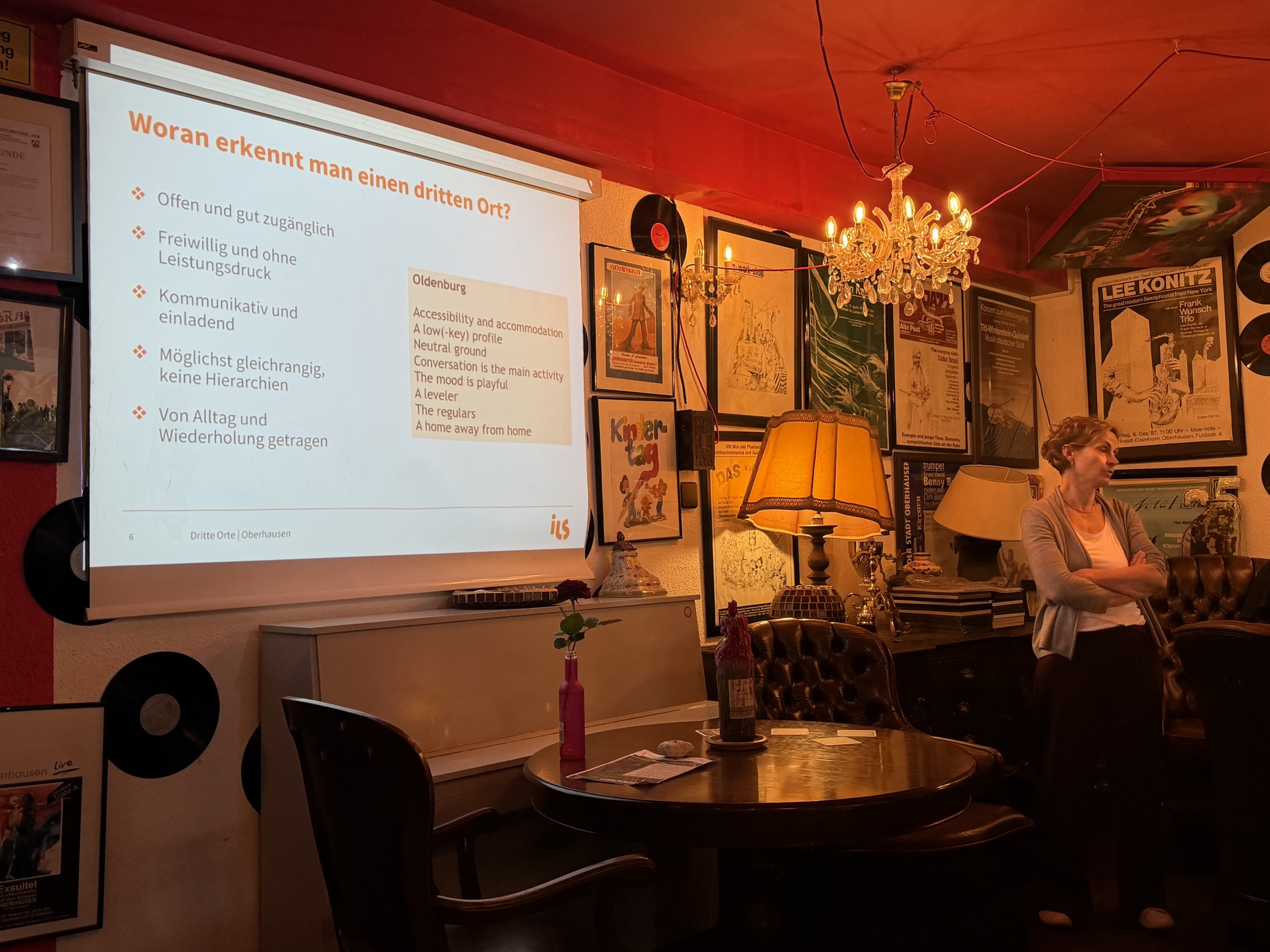
© OWT GmbH
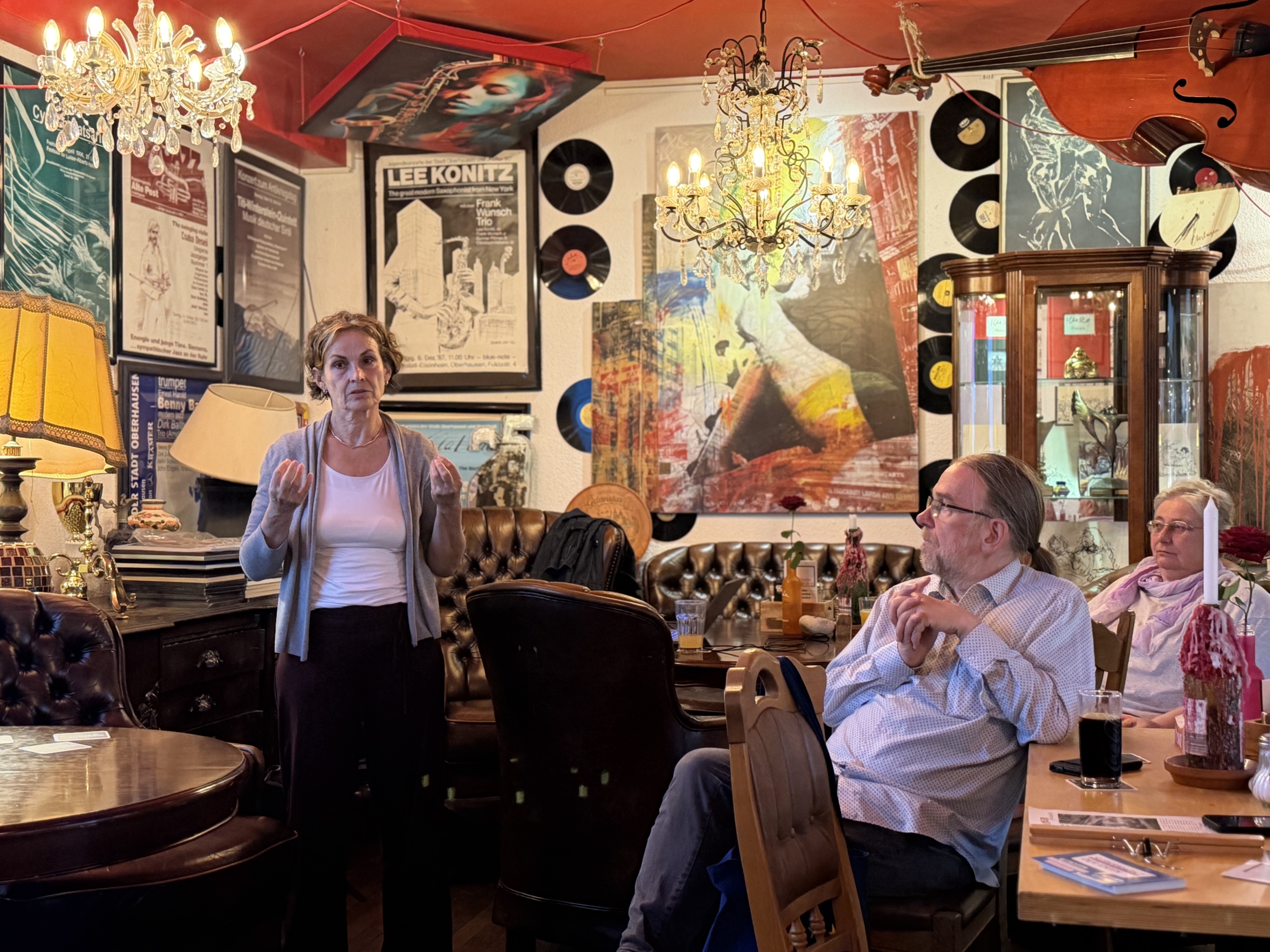
© OWT GmbH