Understanding Urban Change, Shaping Urban Change
The process of urbanisation in the early 21st century is enormously dynamic: Urban spaces emerge, grow and change, their transformation takes many forms and is increasingly discontinuous and disparate. A better understanding of these processes is a central concern for the spatial urban researchers at the ILS. We investigate the various dimensions of urban change at different levels of scale and in international comparison. In active dialogue with practitioners, policy-makers and societal stakeholders, we gain important insights from this for the sustainable transformation and design of urban spaces.
We have these main research interests.
The process of urbanisation in the early 21st century is enormously dynamic: Urban spaces emerge, grow and change, their transformation takes many forms and is increasingly discontinuous and disparate. A better understanding of these processes is a central concern for the spatial urban researchers at the ILS. We investigate the various dimensions of urban change at different levels of scale and in international comparison. In active dialogue with practitioners, policy-makers and societal stakeholders, we gain important insights from this for the sustainable transformation and design of urban spaces.
We have three main research interests.
News
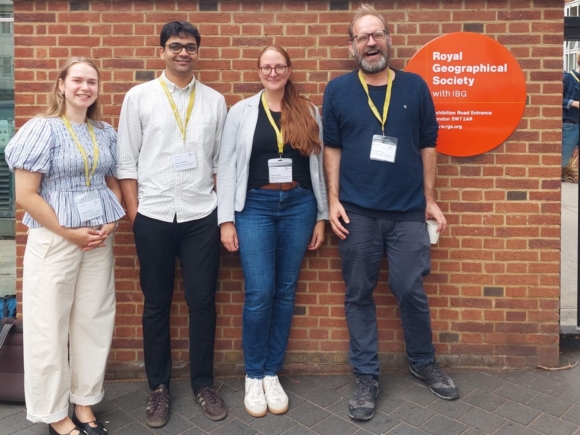
ILS researchers at the RGS-IBG Annual International Conference in London
ILS researchers from the “Mobility and Space” research group attended the RGS-IBG Annual International Conference in London in early September. Dr Thomas Klinger, Theresa Milde, Angelina Atanova and Suyash Shérékar delivered a total of three presentations on the topic of urban mobility. The contributions from the research group covered a variety of topics including Street Transformations, children’s mobilities, evaluation of shared mobility services and the question of Justice. More…
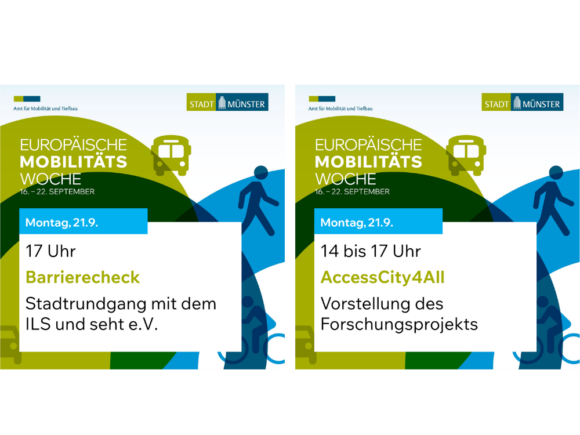
Europäische Mobilitätswoche 2026: AccessCity4All mit Aktionen in Münster
Bei der Europäischen Mobilitätswoche 2026 (16. bis 22. September) stehen klimafreundliche Mobilitätsformen im Mittelpunkt. Die europaweite Aktionswoche steht in diesem Jahr unter der Überschrift „Mobilität für alle Generationen“. Auch in NRW sind zahlreiche Kommunen dabei. Das Team unseres Projekts AccessCity4All stellt am kommenden Montag (21. September) das Forschungsvorhaben an der kreisl Kiste auf dem Domplatz, einem Reallabor mitten in Münster, vor. Mehr…
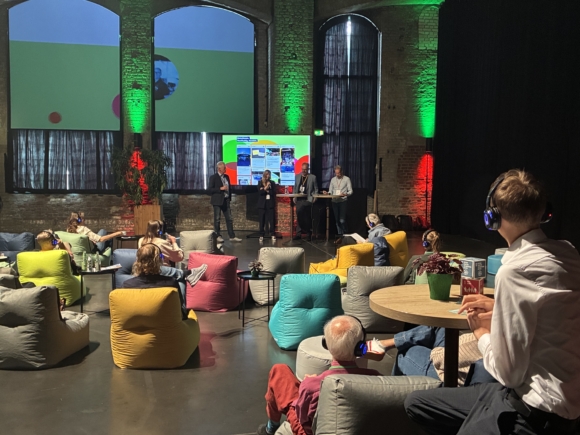
NRW-Nachhaltigkeitstagung: Wie gerecht ist die Mobilität in Stadt und Land?
Die NRW-Nachhaltigkeitstagung ist ein fester Termin in unserem Kalender. Am Donnerstag haben wieder Menschen aus ganz NRW im LokSchuppen Bielefeld gemeinsam Lösungen für die sozialen, ökologischen und ökonomischen Herausforderungen diskutiert. ILS-Wissenschaftler Dr. Thomas Klinger war gemeinsam mit Alexandra Westerkamp (Nahverkehr Westfalen-Lippe), Udo Sieverding (MUNV NRW) und dem Moderator Heiko Appelbaum (Zukunftsnetz Mobilität NRW) Teil des „Dialogs zum Spannungsfeld Daseinsvorsorge am Beispiel Mobilität“. Er betonte, dass angepasste und flexible Mobilitätsangebote notwendig sind, um gleichwertige Lebensverhältnisse in allen Landesteilen Nordrhein-Westfalens zu gewährleisten. Mehr zur NRW-Nachhaltigkeitstagung
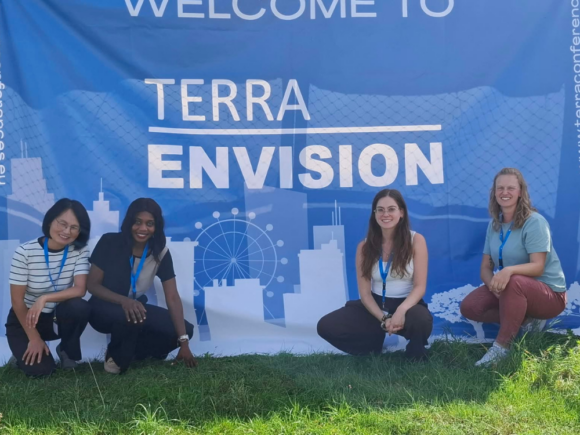
Naturbasierte Lösungen im Fokus: ILS bei der TERRAenVISION
Eindrücke von der TERRAenVISION Konferenz in Trier: Die internationale Konferenz vernetzte Wissenschaft, Politik, Wirtschaft und Praxis, um naturbasierte Lösungen für die großen Herausforderungen von Klimawandel, Biodiversitätsverlust und Ressourcenknappheit zu diskutieren. Wissenschaftlerinnen des ILS brachten ihre Expertise in verschiedenen Sessions ein und präsentierten Einblicke in die Projekte GreenME, IMECOGIP und CATCH4D. Mehr…
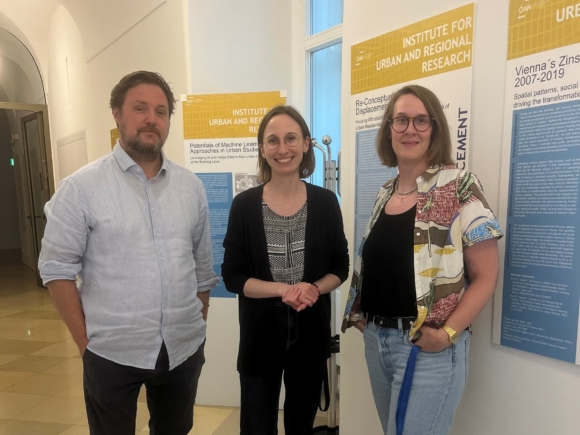
Wissenschaftlicher Austausch mit dem ISR in Wien
ILS-Wissenschaftlerin Dr. Lea Fischer war einen Monat als Gastwissenschaftlerin am Institut für Stadt- und Regionalforschung (ISR) an der Österreichischen Akademie der Wissenschaften, Arbeitsgruppe Wohnen und Urbane Ökonomie. Dort hat sie sich mit den Wissenschaftler*innen u.a. über die gemeinsamen Forschungsthemen prekäres Wohnen und Arbeiten sowie Wohnungslosigkeit und die gemeinsamen partizipativen Forschungsansätze ausgetauscht. Mehr…
Publications

Sustainability goal literacy enables mission-oriented agrifood research
ILS researcher Thomas Weith, together with colleagues, has published an article in the journal “communications sustainability”. Research-driven innovations in agricultural and food systems can advance global sustainability goals, but their complexity requires them to be linked to clear transformation goals. Using a German research programme in the agriculture and food sector as an example, we demonstrate how such integration into transformation pathways can be achieved whilst simultaneously supporting mission-oriented research. https://doi.org/10.1038/s44458-026-00114-x. Further current selected papers can be found here.

Negotiating ‘Left-Behindness’ and Migration-Related Diversity in (New) Arrival Spaces
ILS researchers Hannah Brill, Nils Hans and Isabel Ramos Lobato published an article, in collaboration with Norma Schemschat, Heike Hanhörster and Lara Hartig, in the journal Urban Planning. Building on growing research on changing geographies of migration and “new” arrival destinations, the article examines neighbourhoods across Germany through the lens of “left-behindness.” Drawing on 90 interviews from eight arrival neighbourhoods, the article analyses how “left-behindness” and the arrival of migrants interact in everyday life and local governance. It shows how structural constraints, symbolic representations, and social dynamics reinforce one another, shaping both the challenges and possibilities of migration. The article argues that left-behindness is best understood not as a spatial category but as a relational and processual condition that highlights uneven development and reveals how the challenges of migration-related diversity are locally negotiated and contested. https://doi.org/10.17645/up.11159. Further current publications can be found here.
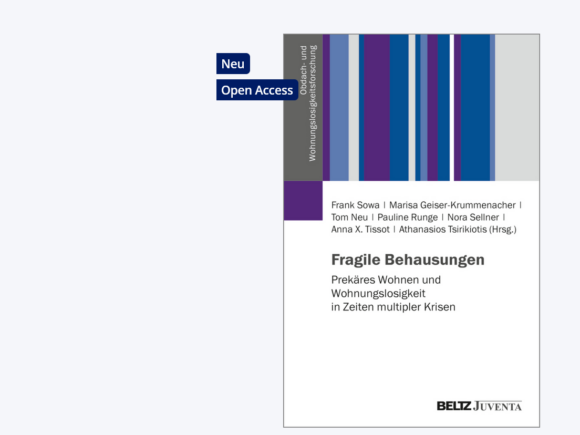
Publikation: Fragile Behausungen
Dr. Lea Fischer und Dr. Michael Kolocek haben einen Fachaufsatz veröffentlicht, in dem sie Ergebnisse aus dem Forschungsprojekt MaBIs (Marginalisierte Bevölkerungsgruppen und die solidarische Innenstadt) präsentieren. Aus einer raumwissenschaftlichen Perspektive diskutieren sie verschiedene Dimensionen informeller Arbeitstätigkeiten, etwa den Verkauf von Straßenmagazinen, das Betteln oder das Pfandsammeln. Der Aufsatz ist einer von über 40 Beiträgen in dem mehr als 800 Seiten umfassenden Sammelband von Frank Sowa und seinem Herausgeber*innenteam. Aus unterschiedlichen Perspektiven widmen sich die Autorinnen und Autoren den Lebenswirklichkeiten von Menschen, die in fragilen Behausungen leben. Der Band ist Open Access erhältlich. Mehr…
Mixed-use ideals, market pressures, and the marginalization of crafts in contemporary urban development: evidence from five German cities
ILS researcher Bastian Heider, together with Stefan Siedentop from TU Dortmund University, has published an article in the journal Planning, Practice and Research. This paper examines the displacement of craft businesses from inner-city areas in five cities in North Rhine-Westphalia, Germany. Drawing on expert interviews with representatives from urban planning, economic development, and chambers of crafts, it identifies a complex interplay of highly context-related factors driving this process – ranging from land-use conversion and rising property values to emission conflicts and limited expansion opportunities. Urban policies have often tolerated or indirectly facilitated the marginalization of the craft sector. Recent planning initiatives show growing awareness of the issue, offering prospects for safeguarding productive uses and preserving mixed-use urban structures that are central to sustainable and resilient city economies. https://doi.org/10.1080/02697459.2026.2668492. Further current publications can be found here.

Free access until June 14, 2026:
Assessing the potential to scale-up urban agriculture in the Global North.
Urban agriculture (UA) is frequently promoted as a pathway to improve urban sustainability, food security, and resilience, yet cross-city evidence on its scalable, system-wide impacts remains limited and methodologically inconsistent. We assess the theoretical scaling potential and food–energy–water (FEW) metabolism implications of expanding low-tech UA across five Global North cities, —London, New York City, Paris, Dortmund, and Gorzów Wielkopolski—using a harmonized two-part framework. The results provide a transferable, cross-city methodology and identify policy-relevant leverage points—especially enabling home gardening, securing land tenure, supporting new farmers or gardeners, and pairing expansion with composting and water-harvesting practices—to design context-sensitive UA scaling strategies. https://authors.elsevier.com/c/1muYocUG5e8ki. Further current publications can be found here.
Events
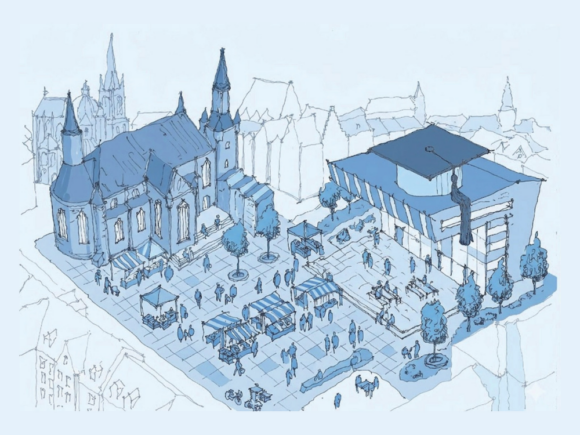
Städtebauliches Kolloquium Sommer 2026: Leerstehende Riesen als neue Stadtbausteine des Wissens
Mit der Veranstaltungsreihe „Städtebauliches Kolloquium“ der RWTH Aachen möchte die Fakultät für Architektur im Sommer 2026 den Diskurs über die Bedeutung und Entwicklung von neuen Konzepten der wissensbasierten Stadtentwicklung anregen. Die zweite von insgesamt drei Veranstaltungen stellt am 16. Juni „Leerstehende Riesen als neue Stadtbausteine des Wissens“ in den Fokus. ILS-Wissenschaftler Prof. Dr. Thomas Weith moderiert die Veranstaltung. Zum Kolloquium
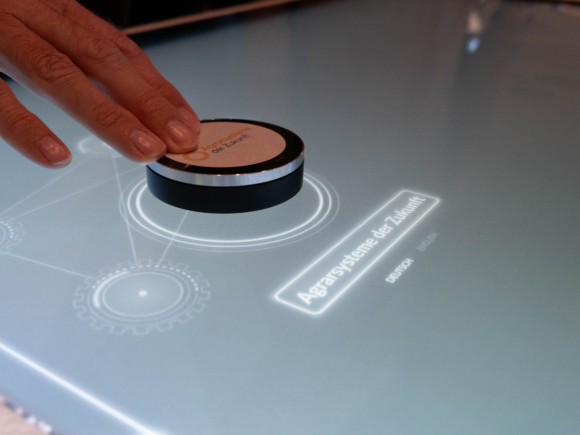
Wissenstransfer anders machen?! Reallabore, Pop-Ups, Performances, mobile und aufsuchende Angebote in der Energiewende
Eine gelingende Energiewende benötigt neben wissenschaftlichen Erkenntnissen, technischen Innovationen, förderlichen ökonomischen und politischen Rahmenbedingungen auch neue gesellschaftliche Praktiken und Ästhetiken. Zusätzlich zu den bewährten Formaten der Wissensvermittlung wie Vorträgen oder Panels gewinnen neue Vermittlungsansätze im Kontext der Energiewende daher an Bedeutung. Die Tagung am 27. April in Gelsenkirchen möchte einen Reflexions- und Experimentierraum für neue Formate des Wissenstransfers eröffnen. Prof. Dr. Thomas Weith stellt dort in einer Session neue Kommunikationsformate zur Wissensvermittlung anhand von Beispielen aus dem ILS vor. Mehr…
Städtebauliches Kolloquium Sommer 2026: Neue Wissensräume als Motor für Stadtentwicklung
Die Veranstaltungsreihe „Städtebauliches Kolloquium“ an der Fakultät für Architektur der RWTH Aachen will im Sommer 2026 den Diskurs über die Bedeutung und Entwicklung von neuen Konzepten der wissensbasierten Stadtentwicklung anregen. Die erste von insgesamt drei Veranstaltungen stellt am 5. Mai „Neue Wissensräume als Motor für Stadtentwicklung“ in den Fokus. ILS-Wissenschaftler Prof. Dr. Thomas Weith ist mit dem Vortrag „Von Menschen und Orten: Altes und neues Wissen aus der Stadt für die Stadt“ im Programm vertreten. Zum Kolloquium
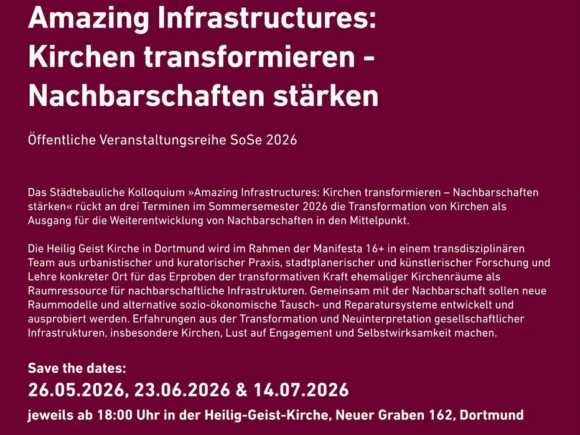
Städtebauliches Kolloquium Dortmund SoSe 2026
Das Städtebauliche Kolloquium der TU Dortmund “Amazing Infrastructures: Kirchen transformieren – Nachbarschaften stärken” rückt an drei Terminen im Sommersemester 2026 die Transformation von Kirchen als Ausgang für die Weiterentwicklung von Nachbarschaften in den Mittelpunkt. Die Heilig-Geist-Kirche in Dortmund wird im Rahmen der Manifest 16+ in einem transdisziplinären Team aus urbanistischer und kuratorischer Praxis, stadtplanerischer und künstlerischer Forschung und Lehre konkreter Ort für das Erproben der transformativen Kraft ehemaliger Kirchenräume als Raumressource für nachbarschaftliche Infrastrukturen. Erster Termin ist der 26.05.2026 ab 18 Uhr in der Heilig-Geist-Kirche, Neuer Graben 162, Dortmund. Mehr…

Wie gut geht es sich in Dortmund?
Wie sieht‘s eigentlich mit der Fußgängerfreundlichkeit in Dortmund Stadt aus? Das fragt eine Veranstaltung des Seniorenbeirats der Stadt Dortmund am Donnerstag, 7. Mai, ab 17 Uhr im Rathaus. Im Mittelunkt stehen dabei Ergebnisse des ILS-Projekts WalkUrban, das die Fußgängerfreundlichkeit in Dortmund untersucht hat. Dr. Janina Welsch und Dr. Anna-Lena Stroms-van der Vlugt stellen die Ergebnisse vor und diskutieren sie mit Podiumsteilnehmenden und Besuchenden der Veranstaltung. Mehr…