Zeitz, Jana Friederike
Jana Friederike Zeitz, M.Sc. Geography
(area of specialisation: Urban and Regional Development Management)

Studied Geography with specialisation on Urban and Regional Development at the Department of Geography, Ruhr University Bochum.
Research interests:
- The right to the city
- Social and spatial inequality
- Urban and neighbourhood development planning
- Housing market and allocation strategies
Contact:
Phone: + 49 (0) 231 9051-244
E-Mail: jana.zeitz@ils-research.de
Job advertisement: Scientifc Director of the ILS
In conjunction with TU Dortmund University, we are looking for a person with a proven academic track record to lead the ILS—Institute for Regional and Urban Development Research. The position is linked to the W3 professorship in “Sustainable Real Estate and Land Development” at TU Dortmund University. We are seeking a leader with internationally recognized research expertise who will shape the strategic development of the ILS and drive the sustainable transformation of cities and regions. The application deadline is August 12, 2026. Further information on the requirements and the application process can be found in the job advertisement.
Innovationskongress NRW: Wirtschaft trifft Wissenschaft
Wie können innovative Geodaten die Klimaanpassung in Städten unterstützen? Beim Innovationskongress NRW am 8. Oktober in Düsseldorf zeigte das ILS anhand des Forschungsprojekts CATCH4D, wie Forschungsergebnisse zur Erreichung der Klimaziele beitragen können. Das Projekt und die darin entwickelte 3D-Wärmelandkarte wurden sowohl in der Ausstellung als auch im Kongressprogramm vorgestellt. Mehr…
Wissenschaft im Wirtshaus: Über dritte Orte an einem dritten Ort
Neben dem Zuhause und dem Arbeitsplatz gibt es einen weiteren informellen Ort der Zusammenkunft: den „Dritten Ort“. Bei der neuesten Ausgabe von „Wissenschaft im Wirtshaus“ im Restaurant Gdanska in Oberhausen entstand daraus eine lebhafte Diskussion. Begleitet wurde diese mit einem Impuls von ILS-Wissenschaftlerin Dr. Sabine Weck. Mehr…
Wissenschaft im Wirtshaus: Über dritte Orte an einem dritten Ort
Neben dem Zuhause und dem Arbeitsplatz gibt es einen weiteren informellen Ort der Zusammenkunft: den “Dritten Ort”. Bei der neuesten Ausgabe von “Wissenschaft im Wirtshaus” im Restaurant Gdanska in Oberhausen entstand daraus eine lebhafte Diskussion. Begleitet wurde diese mit einem Impuls von ILS-Wissenschaftlerin Dr. Sabine Weck.
Neben den allgemeinen Definitionen, die unter anderem auf das Standardwerk vom Soziologen Ray Oldenburg, The Great Good Place, aus den 1980er Jahren zurückgehen, standen vor allem neuere Untersuchungen und Projekte im Fokus. Gerade im Ruhrgebiet haben sich viele Initiativen hervorgetan, wie beispielsweise das Bürgerhaus Dorstfeld „Pulsschlag“ in Dortmund oder „Hier ist nicht da“ in Gelsenkirchen-Ueckendorf. Sie alle werden nicht nur durch festangestellte Mitarbeitende getragen, sondern sind mit dem Viertel und der dortigen Gemeinschaft verwoben, um Akzeptanz und Annahme zu fördern. Ein gutes Beispiel für die Nutzung einer staatlichen Kulturstätte im Sinne dieses Gedankens ist das Rheinische Landestheater in Neuss, in dessen Foyer Bürger:innen zu gemeinsamen Kursen und zum Austausch zusammenkommen.
Für die Stadtentwicklung sind diese „Dritten Orte“ wichtiger denn je: Sie bringen Frequenz in Quartiere, schaffen Räume der Begegnung, wirken Polarisierung entgegen und sind zugleich Zukunftslabore, um künftige Möglichkeiten “auszutesten”. Die Diskussion im Plenum drehte sich daher darum, wie man die Vielfalt der Angebote in Oberhausen – wie den Supermarkt der Ideen, Kitev oder soziokulturelle Zentren – noch sichtbarer machen kann.
Die Veranstaltungsreihe „Wissenschaft im Wirtshaus“ der Oberhausener Wirtschafts- und Tourismusförderung (OWT) bringt Wissenschaftler*innen und interessierte Bürger*innen in ungezwungener Atmosphäre zusammen und schafft Raum für den Austausch über aktuelle Forschung und ihre Bedeutung für den Alltag.
Die Meldung basiert auf einem Text der OWT.
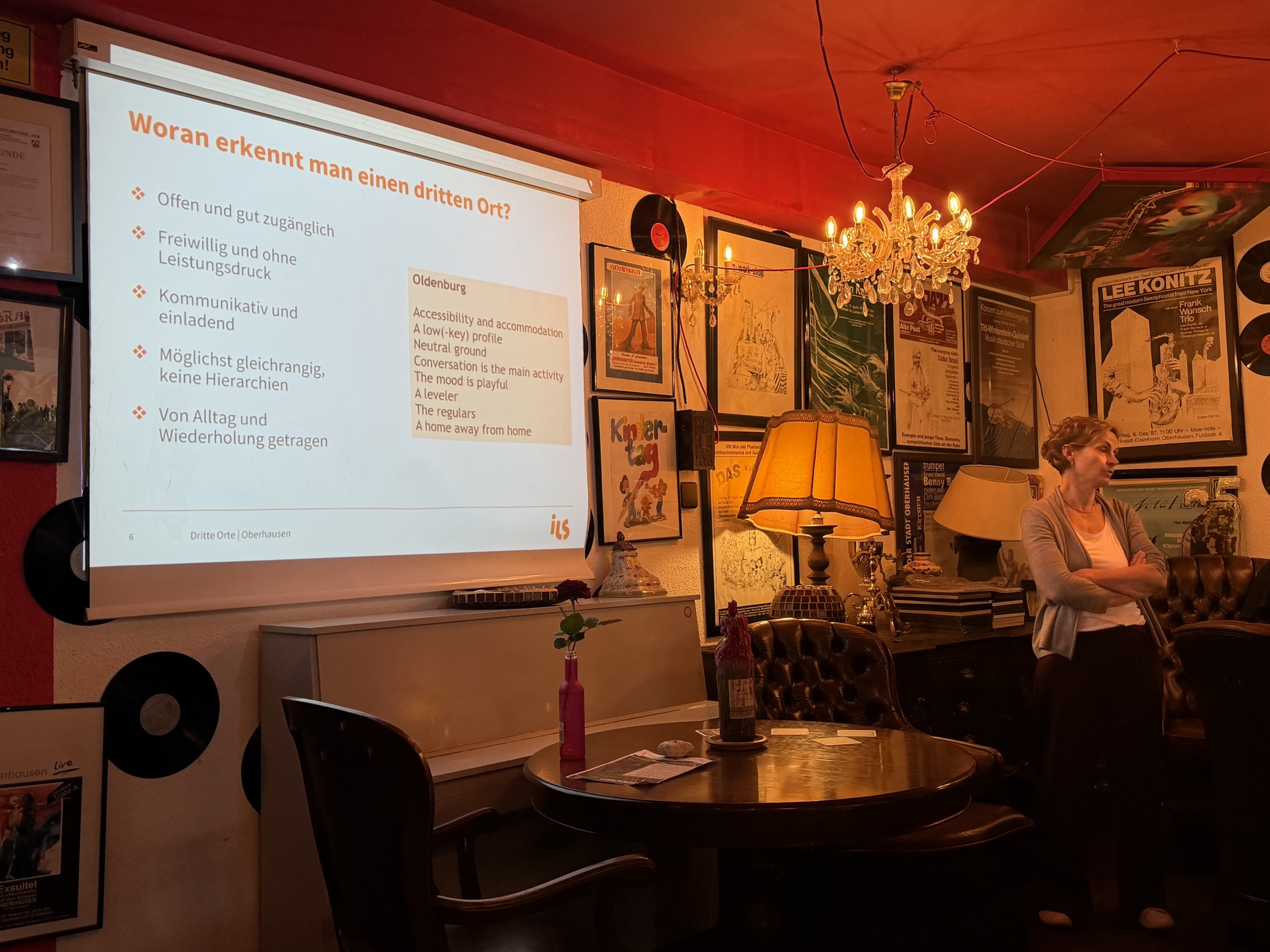
© OWT GmbH
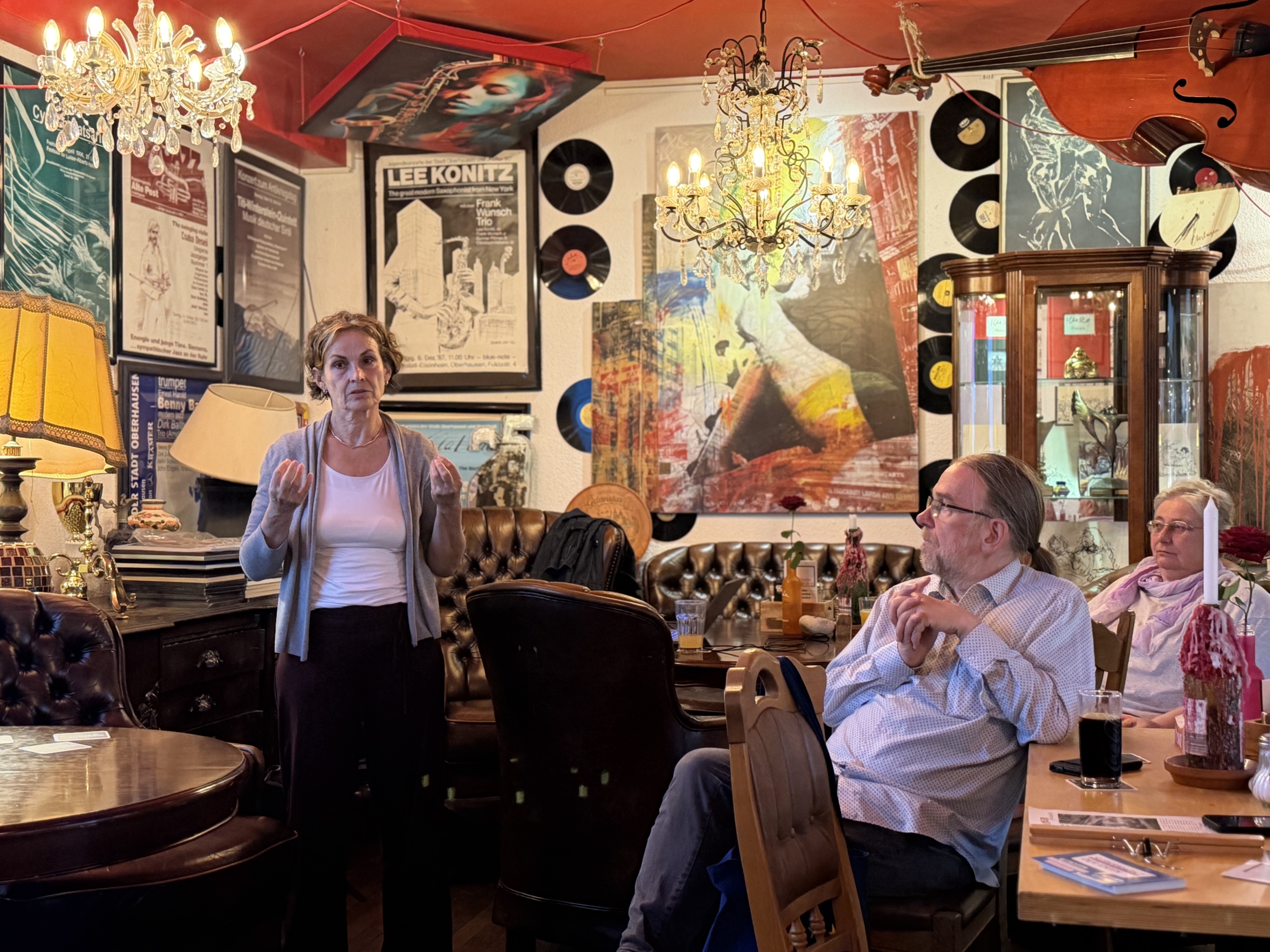
© OWT GmbH
TIME/LESS. Sensing, Planning, Designing in Complex Cities and Regions
ILS researcher Stefano Cozzolino, together with Christian Lamker from the University of Groningen and Fabio Bayro Kaiser from the RWTH Aachen University, published a special issue of ‘Transactions’. Time is a crucial yet often underexplored dimension of spatial planning. This special issue followed up a 2024 conference in Aachen, organised by the AESOP Thematic Group ‘Planning and Complexity’, and brings together perspectives that connect time and complexity as fundamental dimensions of urban change and planning. Its central contribution is to show how engaging explicitly with temporal dynamics can enrich complexity-informed planning, particularly under conditions of uncertainty and non-linearity. The issue explore this topic through three interconnected dimensions: sensing, planning, and designing. https://doi.org/10.24306/TrAESOP.2026.02.002. Further current selected papers can be found here.
Towards regional land-use management: the design process of policy instruments for collective action
ILS researchers Angelika Münter and Peter Stroms-van der Vlugt, together with colleagues from TU Dortmund University, have published an article in the Journal of Environmental Policy & Planning. Drawing on the case of the Bonn/Rhein-Sieg/Ahrweiler region, it examines how shared narratives shape the design of inter-municipal policy instruments for sustainable land-use management. Building on theories of collaborative governance, the paper shows that collaboratively designed soft policy instruments, such as a regional density concept, establish a shared knowledge base and enable more evidence-informed discussion of planning conflicts. They create opportunities to coordinate responses to the tension between housing provision and reducing land take across the region. However, inter-municipal competition, a lack of binding commitments and reliance on project-based funding constrain implementation, which remains dependent on voluntary local ratification. Without institutionalized regional capacities and mechanisms for sharing costs and benefits, jointly developed knowledge does not automatically translate into collective action. https://doi.org/10.1080/1523908X.2026.2740012. Further current selected papers can be found here.